
Loading...
Serving State College, PA and surrounding areas. (814) 996-0130
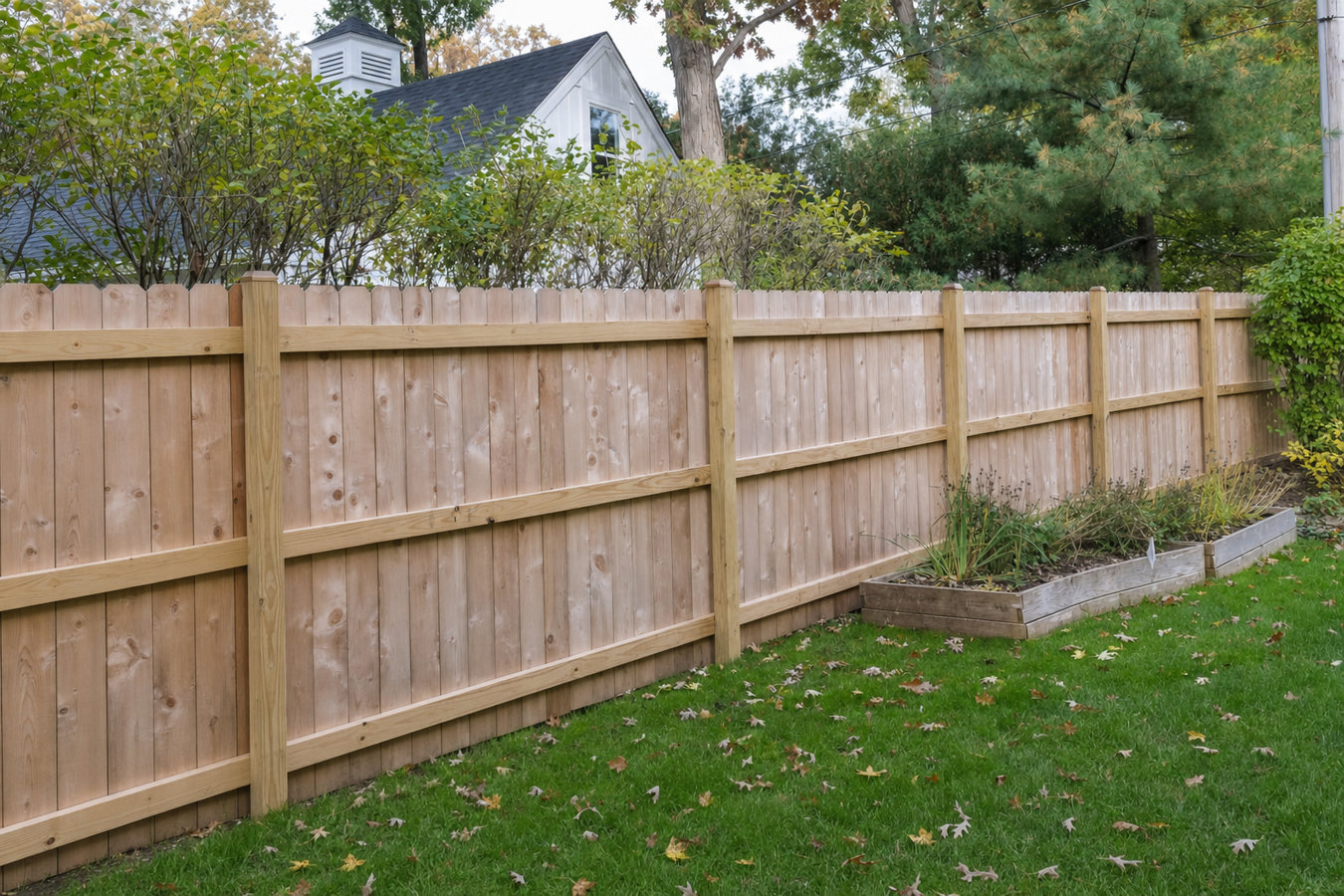
A wood privacy fence transforms your backyard from an open lot into a space you actually want to use - and we build them to stand straight through years of State College winters.
Wood and privacy fence installation in State College, PA means cedar or pressure-treated boards installed with posts set below Centre County's frost line, permits pulled from the Borough or your township, most backyard projects complete in two to three days.
A 6-foot privacy fence changes how your yard feels immediately. State College homeowners - especially those in the denser neighborhoods near Penn State's campus - often describe their backyards as feeling too exposed before a fence goes up. Kids have room to run, dogs have a safe boundary, and you can sit outside without feeling like you are on display. The natural look of cedar or pressure-treated pine adds character that vinyl cannot replicate.
If low maintenance is your top priority, take a look at our vinyl fence installation service - vinyl handles Centre County winters with no painting, staining, or board replacement needed. But if the natural warmth of wood matters to you, wood is the right call.
Push gently on a fence post. If it moves or rocks, the post has likely lost its grip in the ground - often because it was not set deep enough to survive Centre County's freeze-thaw winters, or because the wood at the base has rotted. A leaning fence puts stress on every board and rail attached to it, and the problem gets worse each winter. Patching individual boards stops making sense at some point.
If your fence boards no longer reach close to the ground - or the gap has grown since last year - frost heave may have pushed your posts upward over multiple freeze-thaw cycles. This is a common issue in State College's climate and a sign the original posts were not set below the frost line. Gaps at the bottom defeat the purpose of a privacy fence and let small animals in or out of your yard.
Wood that has never been sealed or stained will gray and dry out over time. Boards that are cracking or pulling away from the rails are no longer doing their job. If more than a quarter of your boards show this kind of wear, replacing individual boards becomes more expensive and time-consuming than starting fresh with a properly sealed new fence.
Many older homes in the State College area - particularly those built near downtown in the mid-20th century - have open backyards with no fencing at all. If you have children, pets, or simply want a defined outdoor space, a new privacy fence is often the first project new homeowners tackle. It immediately changes how usable and comfortable your yard feels.
We install privacy fences in cedar and pressure-treated pine - the two wood species most suited to Pennsylvania's climate. Cedar resists moisture naturally and tends to hold its color and structure longer without aggressive maintenance. Pressure-treated pine is chemically treated to resist rot and insects, making it the more affordable option that still holds up well when properly sealed. Both are available in standard privacy board heights of 6 feet, with custom heights available depending on your zoning situation.
Beyond material choice, we handle every step: permit application with the Borough of State College or your township office, PA 811 utility marking before digging, frost-line post setting, and gate installation with properly adjusted hardware. For sloped yards - common throughout the State College area given the valley terrain - we discuss both stepped and racked installation approaches before we quote, so you know what your fence will actually look like before work begins. Homeowners building a more complete outdoor space sometimes pair a privacy fence with our screened-in porch service for a fully enclosed yard and covered outdoor living area.
Best for homeowners who want natural moisture resistance and a richer, warmer appearance that holds up longer with less maintenance than pine.
A cost-effective option for homeowners who want a solid, durable privacy fence and plan to apply stain or sealant within the first season to extend its life.
Suits homeowners whose yards have significant grade changes - each panel drops in level sections, giving a structured, formal look while keeping the fence functional on a hill.
For yards where you want the fence to follow the contour of the slope more naturally - boards angle with the grade, keeping the bottom closer to the ground throughout.
Centre County's freeze-thaw cycles are hard on wood fence posts. The ground freezes and thaws repeatedly each winter - sometimes multiple times in a single week in fall and spring - and that movement pushes posts that were set too shallow upward over time. A fence that looked fine on installation day can start leaning within a couple of winters if posts were not buried below the frost line. In this area, that means at least 36 inches deep. We also know that wet spring soil - which State College gets reliably from snowmelt and spring rain - affects how reliably concrete cures around posts, which is why timing and technique on installation day both matter. Homeowners in Millheim and across the broader State College area have seen what a difference proper post depth makes after a few hard winters - and it is something we build into every job.
The permit and HOA landscape in State College is also more involved than in many markets. The Borough has height limits that vary by where on your property the fence sits - front yards, side yards, and back yards each have different rules - and many neighborhoods near Penn State's campus have active HOA covenants that govern fence style, color, and placement. Beyond the Borough, each surrounding township has its own permit process. We handle the permit application and can walk you through HOA submission if your neighborhood requires one. A fence built without the right approvals can create real complications when you go to sell your home, and we make sure that does not happen.
We reply within one business day. Then we schedule a free walkthrough of your property to measure the fence line, note any slopes or obstacles, and ask about your goals - privacy, pet containment, curb appeal, or all three. A written quote follows within a few days, with everything itemized.
Before any digging, we pull the required permit from the Borough or your township, and contact Pennsylvania's free 811 service to have underground utility lines marked. You will see small flags in your yard showing where gas, electric, and water lines run. This is required by law and protects your property.
The crew digs holes to frost-line depth, sets each post in concrete, and checks plumb and spacing. This usually takes a full day for a standard backyard. Concrete cures for at least 24 to 48 hours before rails and boards go on - so do not be surprised if the crew leaves after day one with just posts in the ground.
Once posts have cured, rails and privacy boards go up and gates are hung and adjusted for smooth latching. We do a final walkthrough with you before packing up - any concern gets addressed on the spot. We also cover the right time to apply your first sealant coat, which extends the life of the fence significantly.
We walk your property, answer your questions, and give you a clear price - no obligation and no pressure to decide on the spot.
(814) 996-0130We set every post to at least 36 inches - below Centre County's frost depth - and cure them in concrete before boards go on. This is the single biggest factor in whether your fence stays straight after five winters, and we do not cut this corner to save a few hours on installation day.
We handle the Borough of State College permit application - or your township's equivalent - as part of the job. A fence without the right permit can complicate a home sale and may require modification or removal. We make sure your fence is fully documented and above board from day one.
Many State College properties have real grade changes, and a fence that looks fine on a flat lot can look awkward or leave large gaps on a hill if it is not planned correctly. We assess your terrain during the estimate and discuss both stepped and racked options - with photos - before you commit to anything.
Pennsylvania requires contractors doing home improvement work to be registered under the Home Improvement Consumer Protection Act. We are registered and insured, and you can verify any contractor's registration independently through the Pennsylvania Attorney General's Office. Ask before you sign with anyone.
Deep post setting, proper permits, and honest terrain assessment are not extras - they are what separates a fence that stands for 20 years from one that starts leaning after three winters. That is the straightforward standard we hold ourselves to on every job in the State College area, and the U.S. Forest Products Laboratory backs up what we already know from local experience: proper installation and timely sealing are what determine how long a wood fence actually lasts in a climate like central Pennsylvania's.
Add a fully enclosed, bug-free outdoor room to complement your fenced yard - a popular pairing for State College homeowners who use their backyard year-round.
Learn MoreZero-maintenance fencing in privacy, picket, and rail styles - a strong alternative for homeowners who want the look of a defined yard without any painting or staining.
Learn MoreSpring and summer slots fill fast - contact us now to get your estimate and lock in your installation date before the season books up.